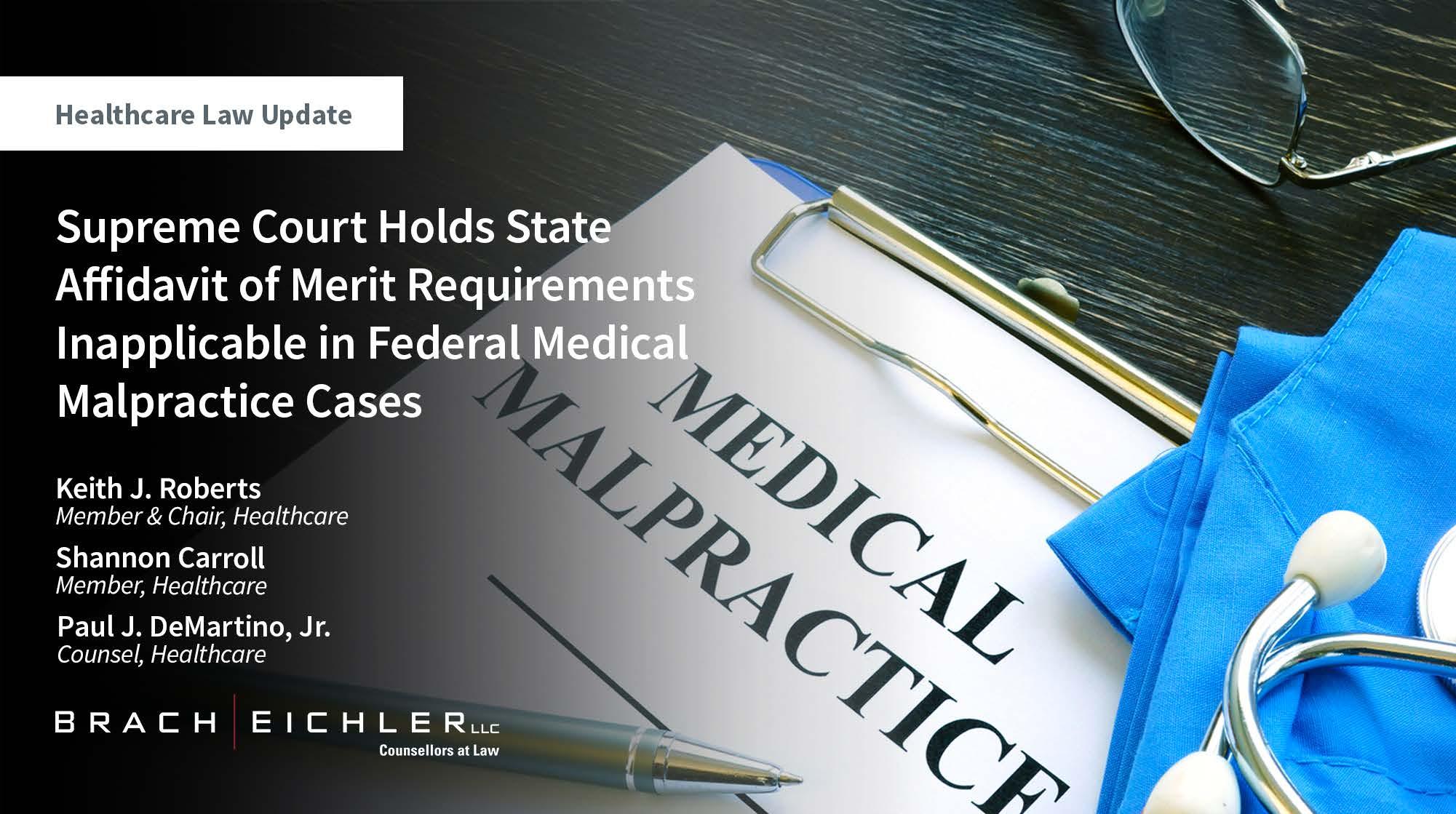
Supreme Court Holds State Affidavit of Merit Requirements Inapplicable in Federal Medical Malpractice Cases
3/1/2026
On January 20, 2026, the United States Supreme Court issued a unanimous decision in Berk v. Choy, holding that state “affidavit of merit” requirements do not apply to medical malpractice actions filed in federal court. The case involved a Florida resident who sued Delaware healthcare providers, including a physician and a hospital, alleging negligent treatment of an ankle injury. Delaware law, similar to that of many states, including New Jersey, requires malpractice plaintiffs to submit an affidavit from a qualified medical professional attesting that the claim has merit. After lower courts dismissed the case for failure to meet this requirement, the Supreme Court reversed, finding that Federal Rules of Civil Procedure 8 and 12 govern the initiation of lawsuits in federal court and require only a “short and plain statement of the claim,” not an expert certification.
For healthcare providers and clinicians, the decision means that plaintiffs able to access federal court, most commonly through diversity jurisdiction where the parties reside in different states, may proceed without satisfying state affidavit of merit requirements that often serve as an early screening tool against frivolous claims. Although the ruling does not alter the substantive standards governing malpractice liability, it removes a procedural barrier that previously led to early dismissal of some cases. Commentators have noted that the decision may encourage forum shopping by plaintiffs seeking to avoid state-imposed requirements, potentially increasing the number of malpractice cases that proceed in federal court.

Keith J. Roberts
Member
Litigation, Healthcare Law
973.364.5201 · 973.618.5585 Fax
kroberts@bracheichler.com
Shannon Carroll
Member
Healthcare Law, Litigation
973.403.3126 · 973.618.5988 Fax
scarroll@bracheichler.com
Paul J. DeMartino, Jr.
Counsel
Healthcare Law, Litigation
973.364.5228 · 973.860.4221 Fax
pdemartino@bracheichler.com




Related Practices: Healthcare Law
Related Attorney: Keith J. Roberts, Shannon Carroll, Paul J. DeMartino, Jr.
Related Industry: Healthcare