

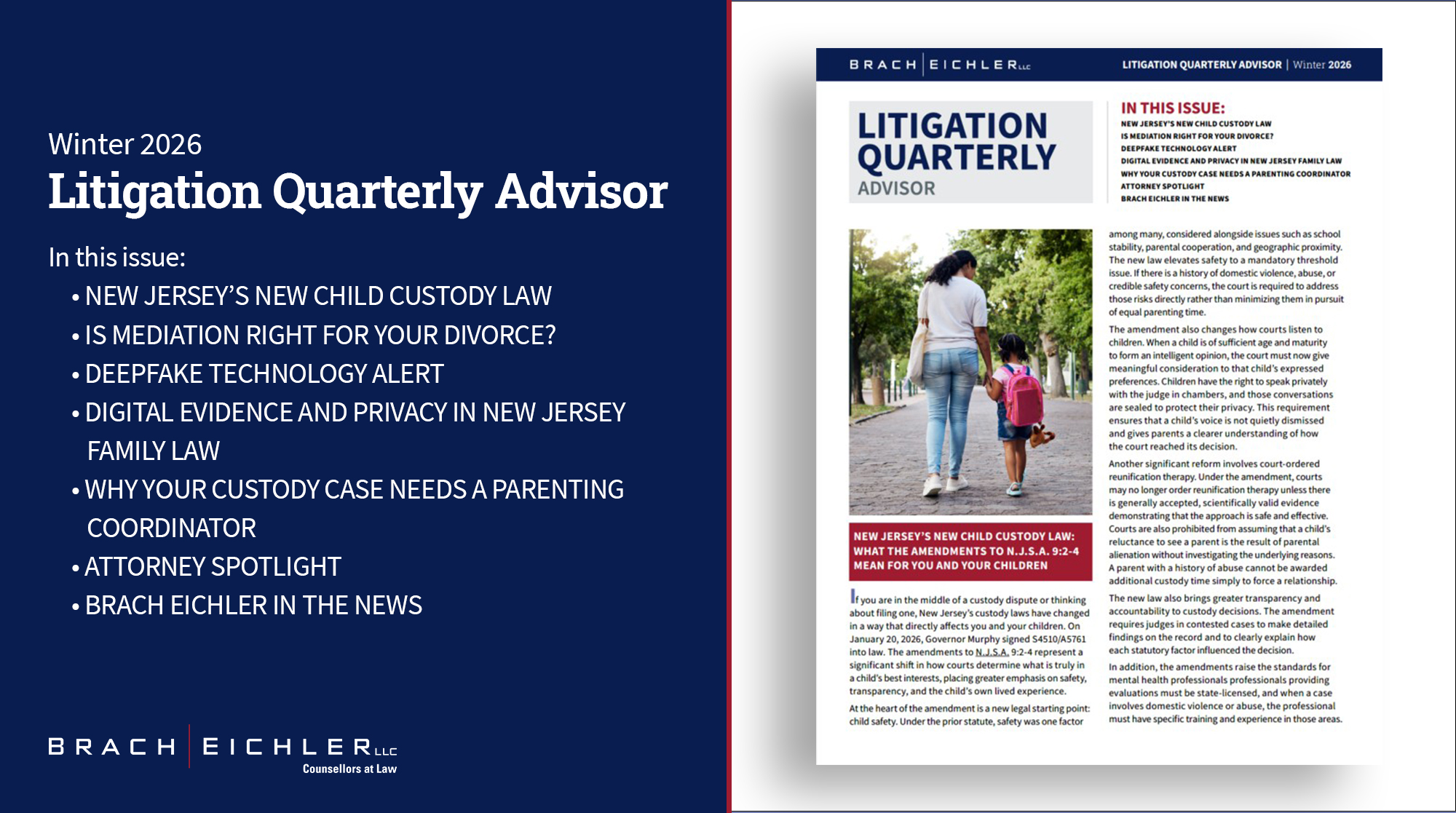



If you are in the middle of a custody dispute or thinking about filing one, New Jersey’s custody laws have changed in a way that directly affects you and your children. On January 20, 2026, Governor Murphy signed S4510/A5761 into law. The amendments to N.J.S.A. 9:2-4 represent a significant shift in how courts determine what is truly in a child’s best interests, placing greater emphasis on safety, transparency, and the child’s own lived experience.
At the heart of the amendment is a new legal starting point: child safety. Under the prior statute, safety was one factor
among many, considered alongside issues such as school stability, parental cooperation, and geographic proximity. The new law elevates safety to a mandatory threshold issue. If there is a history of domestic violence, abuse, or credible safety concerns, the court is required to address those risks directly rather than minimizing them in pursuit of equal parenting time.
The amendment also changes how courts listen to children. When a child is of sufficient age and maturity to form an intelligent opinion, the court must now give meaningful consideration to that child’s expressed preferences. Children have the right to speak privately with the judge in chambers, and those conversations are sealed to protect their privacy. This requirement ensures that a child’s voice is not quietly dismissed and gives parents a clearer understanding of how the court reached its decision.
Another significant reform involves court-ordered reunification therapy. Under the amendment, courts may no longer order reunification therapy unless there is generally accepted, scientifically valid evidence demonstrating that the approach is safe and effective. Courts are also prohibited from assuming that a child’s reluctance to see a parent is the result of parental alienation without investigating the underlying reasons. A parent with a history of abuse cannot be awarded additional custody time simply to force a relationship.
The new law also brings greater transparency and accountability to custody decisions. The amendment requires judges in contested cases to make detailed findings on the record and to clearly explain how each statutory factor influenced the decision.
In addition, the amendments raise the standards for mental health professionals professionals providing evaluations must be state-licensed, and when a case involves domestic violence or abuse, the professional must have specific training and experience in those areas.
The law took effect immediately on January 20, 2026. If you are currently involved in a dispute, considering filing a motion, or preparing for trial, this law will shape the evidence presented, the strategies used in court, and the protections available for your child.
At Brach Eichler Family Services, we understand how personal and high-stakes custody disputes can be. We are already integrating the requirements of these amendments into our approach, whether that means advocating for a child’s voice to be heard, challenging unsafe or unsupported therapeutic interventions, or ensuring the court fully addresses safety concerns before making custody decisions. Our goal is to help you navigate these changes with clarity and confidence, while keeping your child’s well-being at the center of the process.
You can view the new law at: https://pub.njleg.state.nj.us/Bills/2024/S5000/4510_R4.PDF
If you have any questions about this alert, please contact:
Sean Alden Smith, Member | 973.364.5216 | ssmith@bracheichler.com
For families in New Jersey and around the country, commencing the divorce process often raises questions such as how much will the entire process cost? And how long will it take to get divorced? While traditional divorce litigation may be necessary in certain matters, today, less than 10% of all divorce cases actually go to trial. Alternate Dispute Resolution (“ADR”) provides an avenue for parties to settle their conflicts outside of Court litigation. Specifically, mediation as a form of ADR has become an increasingly popular method for parties to take advantage of.
Divorce mediation is where both parties can voluntarily elect to work with a neutral third-party to resolve issues surrounding equitable distribution, custody and parenting time, alimony, etc. In New Jersey, mediation can occur by way of the Court referring the parties to attend mediation with one of its mediators, or the parties may elect to attend private mediation with a mediator of their own choice, all while having their attorneys present to ensure their interests and rights are protected.

One of the most significant differences between choosing mediation over litigation is costs. By litigating through the Courts, spouses will typically get caught up in wanting their “pound of flesh”. As such, litigation fees can get out of hand quickly by arguing over issues via motion practice, several appearances in Court, potentially significant discovery and possible expert fees. On the other hand, mediation involves the parties sharing the costs for the mediator and incentivizes a collaborative effort to resolve certain issues.
While mediation may not be perfect for every situation, it offers a pathway for parties to engage in a more efficient, affordable and less emotionally taxing process than had the parties elected to litigate every issue before the Court. It is a tool anyone going through a divorce should at least attempt to avail themselves of, as it is far better to reach a predictable compromise dictated by the parties, rather than leave it up to a Judge who may not be as familiar with the needs of your family and order an unpredictable outcome.
If you have any questions about this alert, please contact:
Adrien J. Lagarde, Associate | 973.287.4565 | alagarde@bracheichler.com
Deepfake technology (Artificial Intelligence generated audio, video, and images that convincingly mimic real people) has rapidly become more accessible and sophisticated. While often discussed in the context of

politics and cybersecurity, deepfakes are increasingly affecting family law matters, where credibility, intent, and accurate evidence are central. Family law clients should understand the risks, legal implications, and protective measures available.
If you have any questions about this alert, please contact:
Sean Alden Smith, Member | 973.364.5216 | ssmith@bracheichler.com
In New Jersey family law matters, electronic evidence is now routine. Text messages, emails, social media content, financial and messaging applications, location data, and cloud storage frequently appear in divorce, custody, support, and domestic violence cases. While this evidence can be highly persuasive, it also presents significant privacy, admissibility, and ethical challenges.
Digital evidence is commonly used to support or refute claims related to income, assets, parenting ability, domestic violence, and credibility. Courts acknowledge the value of such evidence, but only when it is lawfully obtained, reliably preserved, and properly presented.
Under the New Jersey Rules of Evidence, digital evidence must be relevant and authenticated to be admissible. Authentication requires proof that the evidence is what the proponent claims it to be and that it has not been altered. A screenshot alone may be insufficient if authenticity is challenged. Because digital evidence is
easily manipulated, courts will closely examine how it was collected and maintained, including whether an identifiable chain of custody exists.
Privacy concerns are equally critical. In New Jersey, accessing another person’s emails, messages, social media accounts, cloud storage, or devices without authorization may violate state and federal law, regardless of marital or cohabitation status. Risks arise when individuals bypass security measures, install spyware or tracking software, or intercept communications without lawful consent.
Once litigation is pending or reasonably anticipated, parties have a duty to preserve digital evidence. Preservation steps include disabling auto-delete functions, maintaining devices in their current state, exporting data in native formats, disabling auto-delete, wiping devices and documenting collection efforts.
Timing and presentation are also critical. Digital evidence is most persuasive when it is complete, contextualized, and accurate. Producing full message threads—rather than selective excerpts—enhances credibility, even when some content may be unfavorable. Selective disclosure can invite skepticism and challenges from opposing parties.

When handled properly, digital evidence is a powerful tool in New Jersey family law litigation. Parties should avoid unauthorized access, preserve relevant data, and pursue discovery strategies that respect privacy and proportionality. Thoughtful collection, careful authentication, and responsible presentation can strengthen motions, facilitate settlement, and enhance trial advocacy.
If you have any questions about this alert, please contact:
Carl J. Soranno, Member | 973.403.3127 | csoranno@bracheichler.com

I. What is a Parenting Coordinator?
A Parenting Coordinator is a relatively new role meant to assist parents, lawyers and the Court in high conflict custody cases.
New Jersey Court Rule 5:8D, was implemented on September 1, 2023, to govern the use of Parenting Coordinators in divorce and non-dissolution matters. Anytime the parents repeatedly disagree on what is in the best interest of their children, the case can benefit from appointment of a Parenting Coordinator.
In New York, PC involvement is based on local practice and court decisions rather than a statewide rule. Some districts, like the 8th Judicial District, have developed their own guidelines, however, these are not applicable for all of New York.
As the role of a Parenting Coordinator in both states is defined as a neutral third party to help parents implement parenting plans and resolve day-to-day issues, Parenting
Coordinators cannot make recommendations on financial issues or modify legal and physical custody.
II. How to Have a Parenting Coordinator Appointed
A judge will appoint a Parenting Coordinator if parents have repeatedly litigated and struggle with communication. The Coordinator makes recommendations when parties disagree on parenting plan implementation or other day-to-day parenting issues.
The parties can also agree on the appointment of a Parenting Coordinator and submit a consent order to the court to name a Parenting Coordinator in their case.
III. How Does it Work?
Parenting Coordinators make binding recommendations on specific issues as outlined in the court rule, the court order, and the PCs retainer agreement, but not on financial matters or modifications to legal or physical custody.
A judge can appoint a Parenting Coordinator in divorce litigation, at any time, after a temporary or final custody order, as circumstances require.
The Parenting Coordinator is expected to make a recommendation to help resolve the conflict. After hearing both parents’ goals and ideas, the Parenting Coordinator should issue binding recommendations on the issues, usually after helping parents try to find common ground.
IV. The Benefits of Appointing a Parenting Coordinator
Once a Parenting Coordinator is appointed, the parties take their unresolved issues to the PC after trying to resolve their issues themselves.
Parenting Coordinators continue to play an important role in supporting families as they manage complex custody arrangements and ongoing parenting disputes. The overall impact of parenting coordination remains clear: reducing conflict, streamlining dispute resolution, and promoting healthier co-parenting relationships for the best interest of children and benefit of families.
If you have any questions about this alert, please contact:
Lisa F. Chrystal, P.J.F.P. (Ret.), Counsel | 973.364.8359 | lchrystal@bracheichler.com
Judge Lisa F. Chrystal is a retired Superior Court Judge From New Jersey. Judge Chrystal served as a Judge for 22 years and as the Presiding Judge of the Family Division in Union County for eight years before her retirement in June 2022. She is Chair of the Alternative Dispute Resolution Group at Brach Eichler in Roseland, NJ where she serves as a mediator, arbitrator and Parenting Coordinator. Judge Chrystal is a Court Certified Parenting Coordinator in New Jersey.
Get to know the faces and stories of the people behind the articles in each issue. We invite you
to meet Associate Jessica L. Cascio and Associate Adrien J. Lagarde.
 JESSICA L. CASCIO
Jessica Cascio is an Associate in Brach Eichler’s Family Law Group. She is a strong and compassionate advocate for her clients, handling all aspects of matrimonial and family law, including prenuptial and postnuptial agreements, custody and parenting time, relocation, cohabitation, child support, college contribution, alimony and equitable distribution, as well as post-divorce disputes. With a 3 ½ year old daughter and a 5-month-old son, Jessica spends a lot of time reading stories, doing arts and crafts, baking cupcakes and cookies, and enjoying the happy chaos.
 ADRIEN J. LAGARDE
Adrien Lagarde is an Associate at Brach Eichler, LLC. Adrien concentrates his practice in matrimonial and family law including divorce, custody and parenting time disputes, alimony and child support, enforcement or modification of support, equitable distribution of assets, pre-marital agreements, adoption, and appellate practice. Adrien likes to stay active, whether that’s hitting the gym, working on his golf swing or finding new hobbies to engage in. Otherwise, he is usually exploring new parts of the city, traveling, going out with friends and spending time with family and his goldendoodle Lila.

On February 7, Litigation Member Sean Smith, recorded a podcast episode of The Divorce Hour with Ilyssa Panitz discussing “A Practical Guide to the Do’s and Don’ts During a Divorce.”
On February 4, Judge Lisa Chrystal provided a bylined article for New Jersey Law Journal entitled, “Why Your Custody Case Needs a Parenting Coordinator.”
On January 29, Litigation Counsel Eric Boden issued an alert entitled, “The Neighborhood May Have Changed, But An Old Restrictive Covenant May Still Apply” about why real estate purchasers must scrutinize all easements and covenants to fully understand the permissible uses for a property of interest.
On January 9, Litigation Member Rose Suriano wrote a bylined article for New Jersey Law Journal entitled, “Litigation Trends Every Business Should Know Heading into 2026.”
On December 10, Labor and Employment Member Jay Sabin and Counsel Sarah A. Gober issued an alert entitled, “The FMLA In Focus: Recently Issued Guidance About Calculating Leave Entitlements for Intermittent and Reduced Schedule Leaves.”
WINS AND SIGNIFICANT BRACH EICHLER LITIGATION DEVELOPMENTS

Attorney Advertising: This publication is designed to provide Brach Eichler LLC clients and
contacts with information they can use to more effectively manage their businesses. The contents
of this publication are for informational purposes only. Neither this publication nor the lawyers who
authored it are rendering legal or other professional advice or opinions on specific facts or matters.
Brach Eichler LLC assumes no liability in connection with the use of this publication.

Stan Barrett | 973.364.5210 | sbarrettl@bracheichler.com
Shannon Carroll | 973.403.3126 | scarroll@bracheichler.com
Matthew M. Collins | 973.403.3151 | mcollins@bracheichler.com
Riza I. Dagli | 973.403.3103 | rdagli@bracheichler.com
Charles X. Gormally | 973.403.3111 | cgormally@bracheichler.com
Anthony M. Juliano | 973.403.3154 | ajuliano@bracheichler.com
Thomas Kamvosoulis | 973.403.3130 | tkamvosoulis@bracheichler.com
Bob Kasolas | 973.403.3139 | bkasolas@bracheichler.com
Andrew R. Macklin | 973.447.9670 | amacklin@bracheichler.com
Eric Magnelli | 973.403.3110 | emagnelli@bracheichler.com
Stuart J. Polkowitz | 973.403.3152 | spolkowitz@bracheichler.com
Anthony M. Rainone | 973.364.8372 | arainone@bracheichler.com
Richard B. Robins | 973.447.9663 | rrobins@bracheichler.com
Jay Sabin | 973.596.8987 | jsabin@bracheichler.com
Sean Alden Smith | 973.364.5216 | ssmith@bracheichler.com
Carl J. Soranno | 973.403.3127 | csoranno@bracheichler.com
Michael A. Spizzuco, Jr. | 973.364.8342 | mspizzuco@bracheichler.com
Frances B. Stella | 973.403.3149 | fstella@bracheichler.com
Rose Suriano | 973.403.3129 | rsuriano@bracheichler.com
Lindsay P. Cambron | 973.364.5232 | lcambron@bracheichler.com
Doris Cheung | 973.364.8309 | dcheung@bracheichler.com
Hon. Lisa F. Chrystal, P.J.F.P.(Ret.) | 973.364.8359 | lchrystal@bracheichler.com
Mark E. Critchley | 973.364.8339 | mcritchley@bracheichler.com
Edward Ellersick | 973.364.5205 | eellersick@bracheichler.com
Sarah A. Gober | 973.364.8375 | sgober@bracheichler.com
Michael A. Rienzi | 973.364.5226 | mrienzi@bracheichler.com
Thomas J. Spies | 973.364.5235 | tspies@bracheichler.com
Jenna N. Lofaro | 973.287.4559 | jlofaro@bracheichler.com
Robyn K. Lym | 973.403.3124 | rlym@bracheichler.com
Katelyn A. Marquez | 973.403.3153 | kmarquez@bracheichler.com
Ashley Matias | 973.364.8330 | amatias@bracheichler.com
John Simeone | 973.447.9665 | jsimeone@bracheichler.com
Zachary Q. Sinkiewicz | 973.287.4563 | zsinkiewicz@bracheichler.com
Cara Joy Skelley | 973.403.3132 | cskelley@bracheichler.com
Roseland, NJ | New York, NY | West Palm Beach, FL | Alpharetta, GA | www.bracheichler.com | 973.228.5700
STAY CONNECTED! FOLLOW US 


