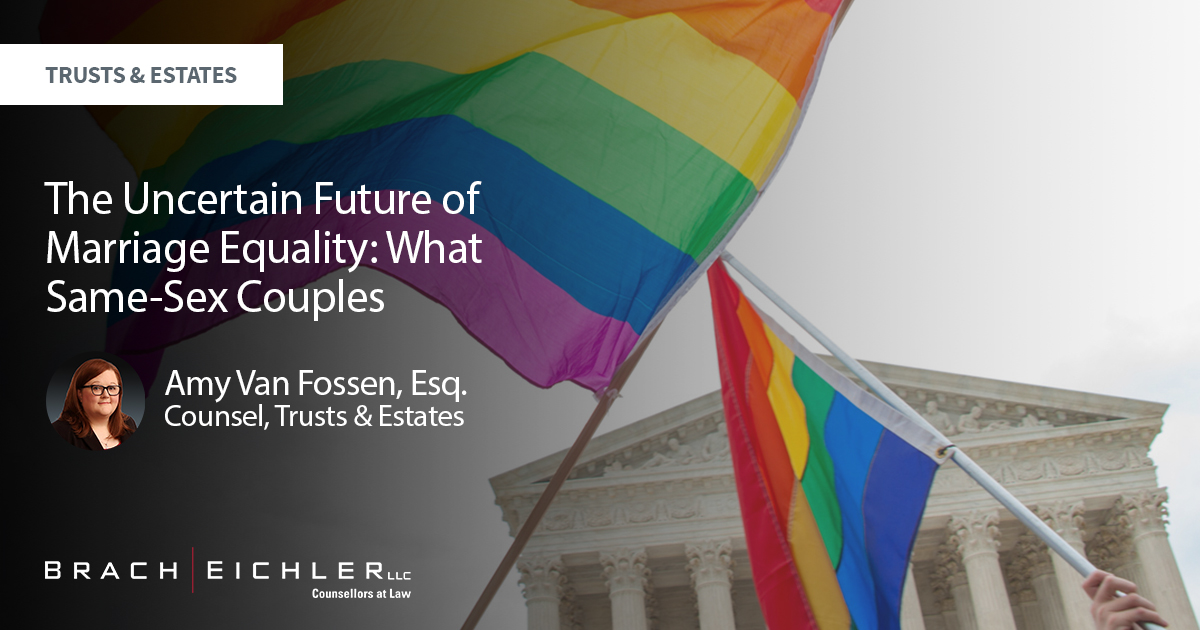
The Uncertain Future of Marriage Equality: What Same-Sex Couples Should Know
6/26/2026
In November 2025, the Supreme Court declined for a second time to hear an appeal by Kim Davis, the former county clerk of Rowan County, Kentucky, who famously refused to issue marriage licenses following the landmark 2015 decision in Obergefell v. Hodges, which legalized same-sex marriage nationwide. In the original case, the Court rejected Davis’s claim that being required to issue marriage licenses to same-sex couples violated her First Amendment rights.
When Davis’s first appeal to the Supreme Court was rejected in 2019, it drew little attention because few legal observers had expected a serious challenge to marriage equality. But given changes in the composition of the Supreme Court since the 2015 Obergefell decision and the Supreme Court’s 2022 decision in Dobbs v. Jackson Women’s Health Organization (which overturned Roe v. Wade and ended the 50 year constitutional right to abortion access), Davis’s 2025 appeal drew significant attention from legal observers and advocacy groups on both sides of the issue.
Despite the Supreme Court’s decision not to hear Davis’s second appeal, questions about the long-term durability of Obergefell remain. Various organizations exist for the specific purpose of identifying and funding cases to challenge Obergefell, and each new case has the potential to end marriage equality at the federal level. Same-sex couples should be aware of these developments and consider taking proactive steps to protect themselves and their families.
More than two dozen states have pre-existing constitutional and/or legislative bans on same-sex marriage that are currently unenforceable only due to Obergefell. According to the Movement Advancement Project, approximately 60% of LGBTQ+ adults live in states where same-sex marriage would cease to be legally recognized if Obergefell were overturned. Lawmakers in several states, including Idaho, Michigan, Montana, North Dakota, and South Dakota, have introduced measures seeking to challenge Obergefell. Recent actions at the federal level which impact and/or restrict the rights of LGBTQ+ individuals, including executive orders regarding the legal recognition of biological sex, transgender participation in sports and military service, and federal grant funding for LGBTQ+ health research, suggest that federal intervention to preserve same-sex marriage is unlikely if the Supreme Court were to overturn Obergefell.
Given the evolving legal landscape surrounding LGBTQ+ rights and ongoing challenges to Obergefell, it is clear that same-sex couples cannot rely solely on the legal protections afforded by marriage in the same way heterosexual couples can. So what steps can same-sex couples take to protect themselves and their families? Comprehensive estate and family planning is the key to providing additional security regardless of future legal developments.
If Obergefell were overturned, same-sex couples could lose the legal right to inherit from each other, access each other’s financial accounts or medical records in the event of incapacitation, and be recognized as “next-of-kin” with authority to make medical decisions for each other. A comprehensive estate plan- including wills naming each other as beneficiaries and powers of attorney, healthcare directives, and HIPAA releases designating each other as agents- would allow same-sex couples to access financial and medical records, and to make financial and medical decisions for each other. Without these documents in place, there is a risk not only that a couple’s wishes will not be carried out but also that a surviving spouse could be excluded from decision-making and blocked from any inheritance at all. A properly prepared comprehensive estate plan can protect a same-sex couple regardless of the legal status of their marriage.
Additionally, it is important that the non-biological parent in a same-sex family legally establish parental rights over their children through a process known as confirmatory or second-parent adoption. Being listed on a child’s birth certificate alone may not be sufficient if Obergefell were overturned. Parental rights established by court order through adoption are recognized in all states, even if same-sex marriage is not. This protects not only the non-biological parent’s relationship with their children in the event of divorce or death of the biological parent, but also the children’s legal right to inherit from their non-biological parent.
Bottom Line: The future of same-sex marriage may be uncertain, but comprehensive estate and family planning can offer same-sex couples greater certainty and legal protection for their families.
If you are in need of specialized estate or family planning, or if you want someone knowledgeable to review your existing planning to ensure your family is protected, please contact Amy Van Fossen by phone, 973-447-9675 or e-mail, avanfossen@bracheichler.com.

Amy Van Fossen
Counsel
Trusts and Estates, Tax
973-447-9675 · 973-618-5939 Fax
avanfossen@bracheichler.com




Related Practices: Trusts and Estates
Related Attorney: Amy Van Fossen