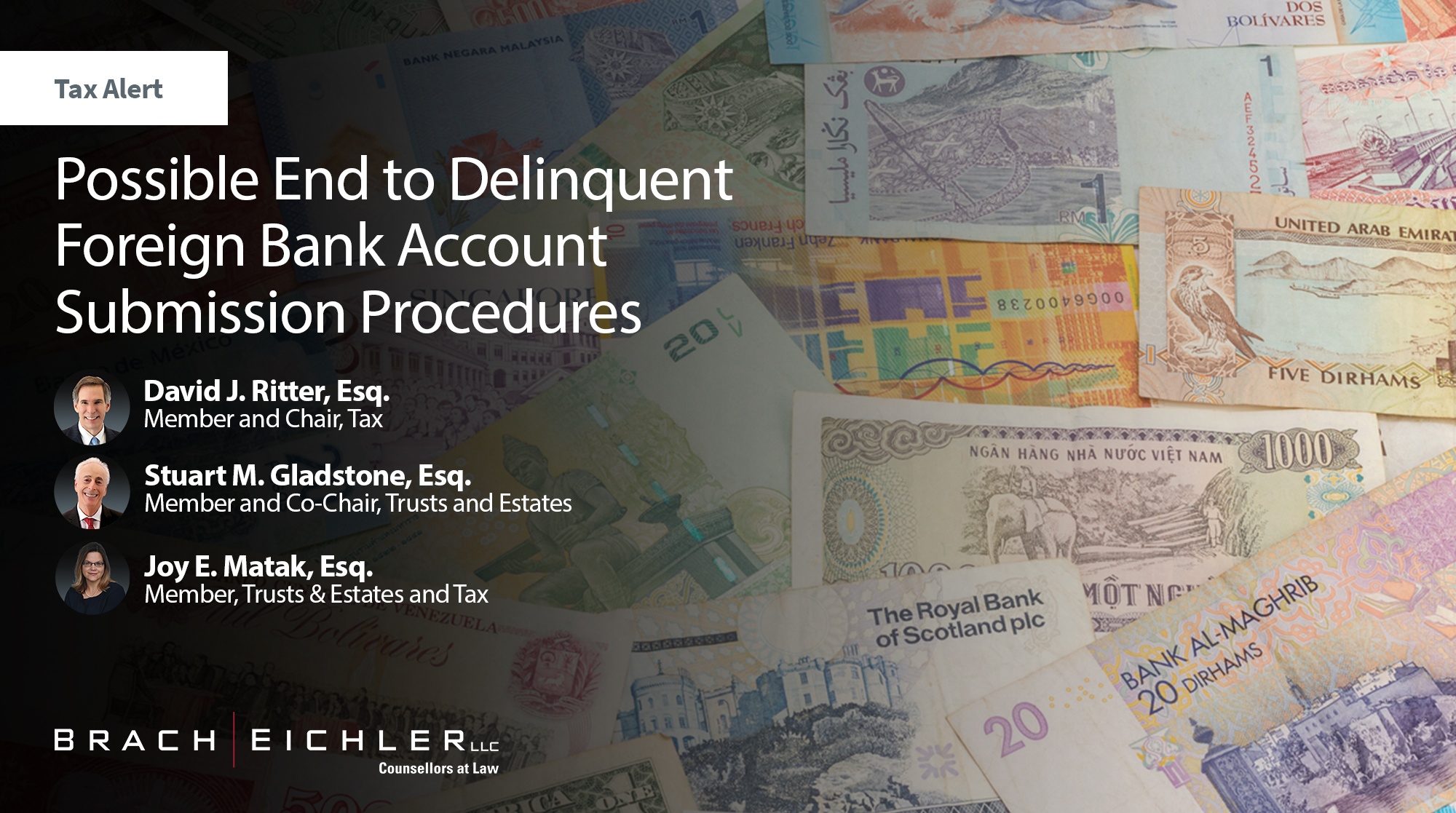
Possible End to Delinquent Foreign Bank Account Submission Procedures
Published: 8/25/2026
The FBAR (Report of Foreign Bank and Financial Accounts, filed as FinCEN 114) is the annual U.S. government report used to disclose financial accounts located outside the United States. This report must be filed if you are a U.S. person whose combined foreign account balance exceeds $10,000 at any time within a calendar year.
For several years, the IRS has provided administrative pathways for taxpayers seeking to bring themselves into compliance with past-due filing requirements. These programs are attractive to taxpayers because they usually allow the taxpayer to reenter the reporting system with some measure of protection from criminal prosecution and, in some cases, civil penalties. In dealing with international returns and compliance, one such program was the Delinquent FBAR Submission Procedure. On July 1, 2026, the webpage was removed from the IRS website, leading practitioners to conclude that the program has ended. To readers familiar with our recent Tax Alerts, the removal and posting of administrative programs comes as no surprise.
The Delinquent FBAR Submission Procedures were intended for taxpayers whose only compliance issue was failing to file FBARs. The IRS promised not to impose an FBAR penalty if the taxpayer had properly reported all income from foreign accounts, paid all tax due, and submitted delinquent FBARs before being contacted by the IRS.
The possible discontinuance of the program does not automatically trigger penalties. Under the applicable statute, the Secretary may impose civil penalties. It is impossible to determine prospectively if each late filing will be examined. The FBAR form itself does provide a drop-down tab that permits the taxpayer to select a reason or explain the cause for the failure to timely file.
It is unknown if this represents a change in IRS policy.
Going forward, the taxpayer’s course of action will depend on the individual situation, including whether to use the Streamlined Filing Compliance Procedures, which result in a 5% miscellaneous penalty, or to submit the returns through the normal procedure with a reasonable cause statement.
In light of this uncertainty, taxpayers with unfiled FBARs should not assume that the prior delinquent submission pathway remains available or that late filings will be penalty-free. If you think you may have missed FBAR filing obligations, contact a Brach Eichler Tax Law attorney today to determine the most appropriate compliance strategy.
David J. Ritter, Esq., Member and Chair, Tax, at dritter@bracheichler.com or 973-403-3117
Stuart M. Gladstone, Esq., Member and Co-Chair, Trusts and Estates, at sgladstone@bracheichler.com or 973-403-3109
Joy E. Matak, Esq., Member, Trusts and Estates and Tax practices, at
jmatak@bracheichler.com or 973-364-8307

David J. Ritter
Member
Tax, Corporate Transactions & Financial Services, Trusts and Estates
973.403.3117 · 973.618.5517 Fax
dritter@bracheichler.com
Stuart M. Gladstone
Member
Trusts and Estates, Corporate Transactions & Financial Services, Tax
973.403.3109 · 973.618.5509 Fax
sgladstone@bracheichler.com
Joy Elizabeth Matak
Member
Trusts and Estates, Tax
973.287.4286 · 973.602.8673 Fax
jmatak@bracheichler.com


Related Practices: Tax, Trusts and Estates
Related Attorney: David J. Ritter, Stuart M. Gladstone, Joy Elizabeth Matak