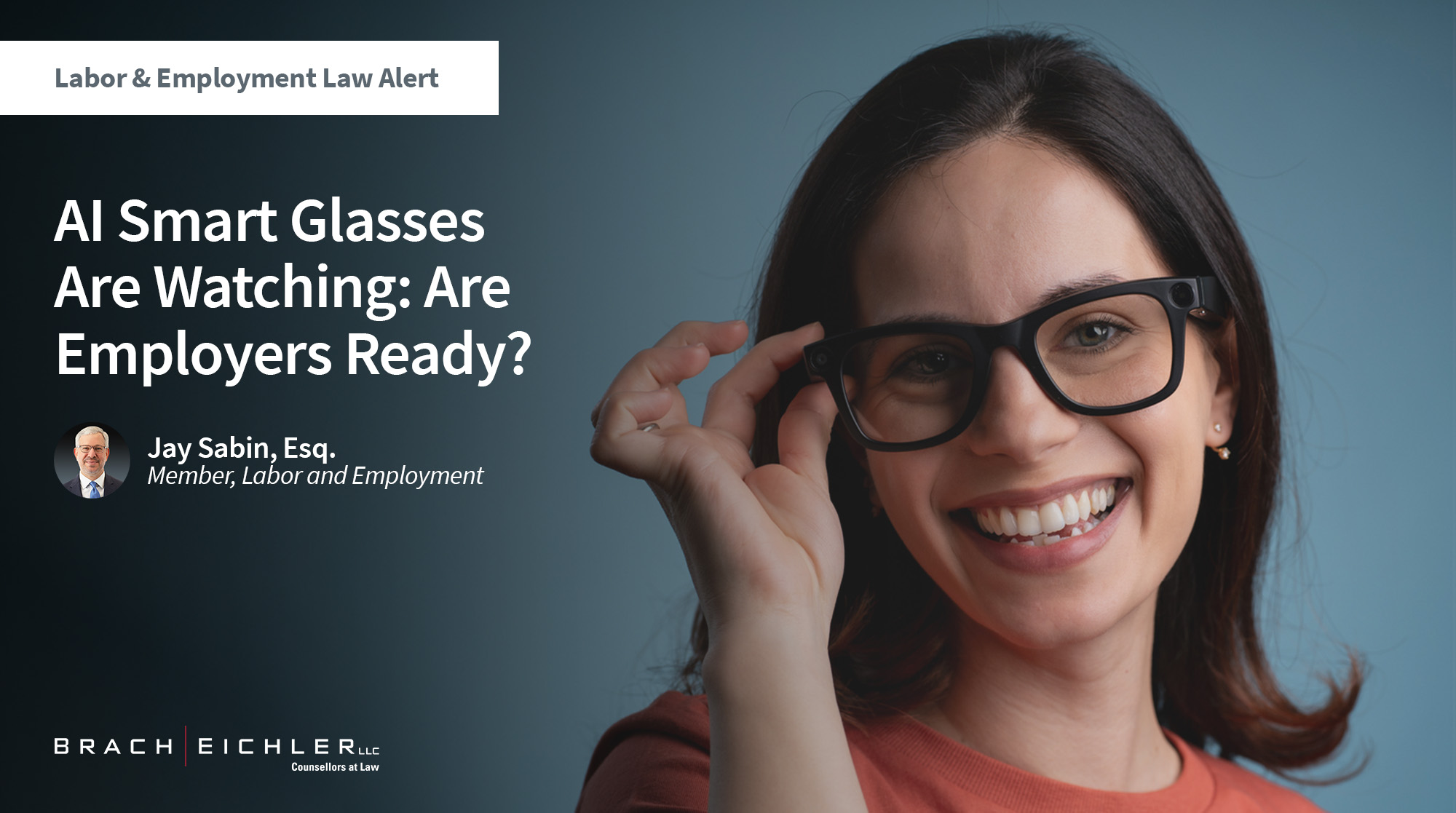
AI Smart Glasses Are Watching: Are Employers Ready?
Published: 9/14/2026
“Smart glasses” – eyewear that records audio and video and, with newer models, transmits those recordings to AI large language model vendors to generate content – are becoming more commonplace. Domestic sales reached $2.5B last year, and a compounded annual growth rate in excess of 20% is expected over the next decade, according to some estimates. Their adoption and donning in the workplace are raising some very serious concerns for employers. Proactive employers have instituted policies either prohibiting or limiting their use, whereas other employers are encouraging their use to perform certain job duties.
As a recording device, smart glasses raise the same concerns prompted by an employee’s use of any recording device in the workplace:
- the recording may be illegal if conducted in a jurisdiction requiring the consent of all parties to being recorded;
- the surreptitious recording of co-workers inherently makes people uneasy to speak freely and may violate existing employer policy;
- the recording of confidential information may violate employer policy and, in certain circumstances (such as with HIPAA protected information), may violate the law;
- an employee covered by the National Labor Relations Act may have the right to record in the workplace for mutual aid and protection;
- the use of smart Glasses might be a reasonable accommodation of an employee’s disability;
- and the employer’s sanction of recording may violate the law of some jurisdictions unless the employer provides advance notice.
Employer concerns are compounded when the smart glasses are AI-enhanced. The transmission of workplace information without employer authorization to a third party that will use that information not only to generate content for the specific user but also, almost certainly, to generate content for millions of other users raises very problematic issues for any employer. It’s not far-fetched that the image of a co-worker or the text of highly confidential information could be included in content generated for any user of that AI large language model.
Employer responses to these issues will vary. Some employers may desire to ban smart glasses from the workplace. Other employers may want to place limits on their use. What is not recommended, however, is to ignore the issue until an employee reports to management a co-worker’s use of smart glasses at work.
For more information about how your organization can address smart glasses in the workplace, or manage any aspect of staff use of AI, please contact:
Jay Sabin, Esq., Member, Labor and Employment Practice at 917.596.8987 or jsabin@bracheichler.com

Jay Sabin
Member
Labor and Employment, Litigation, Cannabis Industry
917.596.8987 · 973.618.5907 Fax
jsabin@bracheichler.com


Related Practices: Labor and Employment
Related Attorney: Jay Sabin