
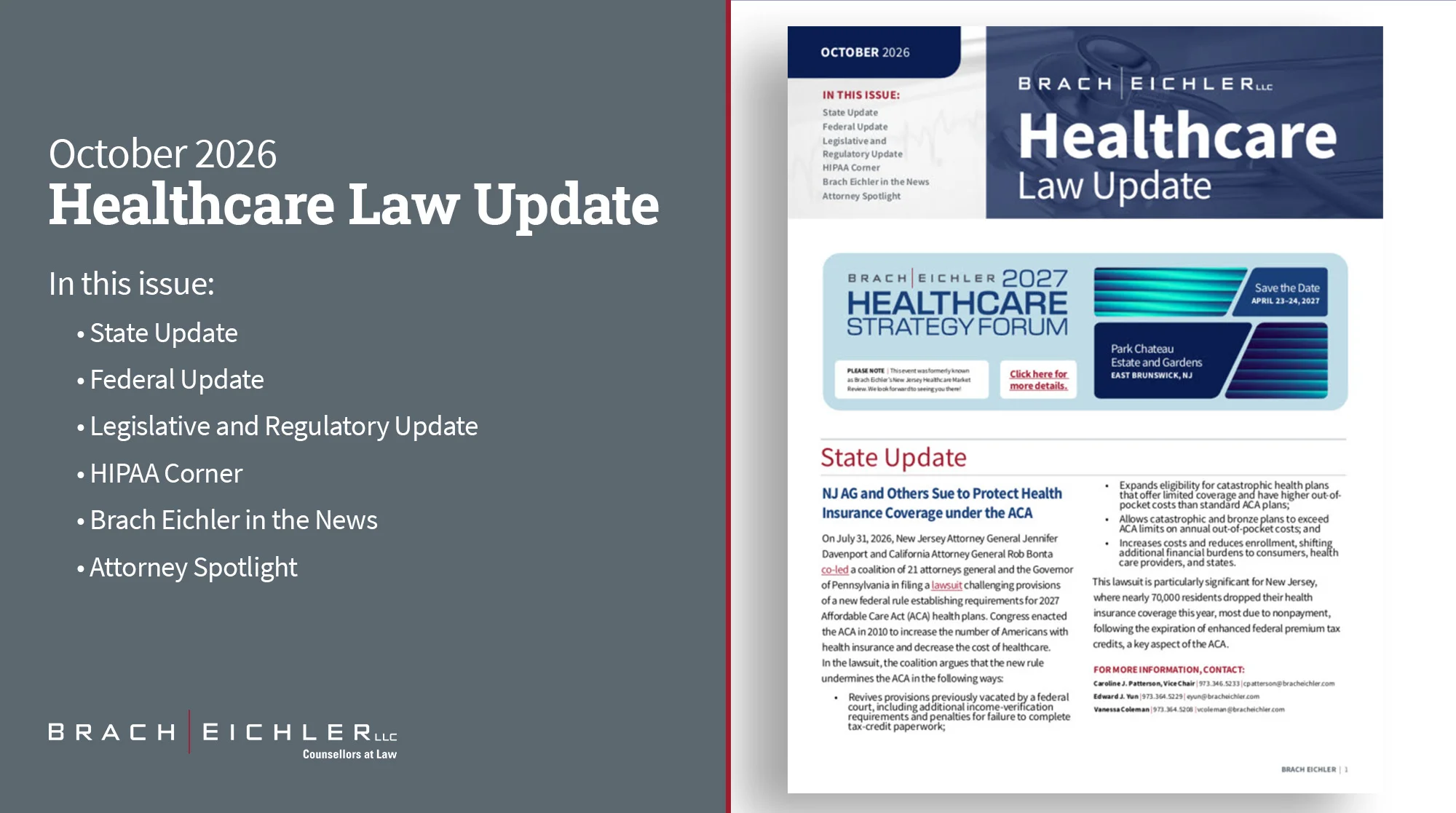



On July 31, 2026, New Jersey Attorney General Jennifer Davenport and California Attorney General Rob Bonta co-led a coalition of 21 attorneys general and the Governor of Pennsylvania in filing a lawsuit challenging provisions of a new federal rule establishing requirements for 2027 Affordable Care Act (ACA) health plans. Congress enacted the ACA in 2010 to increase the number of Americans with health insurance and decrease the cost of healthcare. In the lawsuit, the coalition argues that the new rule undermines the ACA in the following ways:
- Revives provisions previously vacated by a federal court, including additional income-verification requirements and penalties for failure to complete tax-credit paperwork;
- Expands eligibility for catastrophic health plans that offer limited coverage and have higher out-of-pocket costs than standard ACA plans;
- Allows catastrophic and bronze plans to exceed ACA limits on annual out-of-pocket costs; and
- Increases costs and reduces enrollment, shifting additional financial burdens to consumers, health care providers, and states.
This lawsuit is particularly significant for New Jersey, where nearly 70,000 residents dropped their health insurance coverage this year, most due to nonpayment, following the expiration of enhanced federal premium tax credits, a key aspect of the ACA.
FOR MORE INFORMATION, CONTACT:
Caroline J. Patterson, Vice Chair | 973.346.5233 | cpatterson@bracheichler.com
Edward J. Yun | 973.364.5229 | eyun@bracheichler.com
Vanessa Coleman | 973.364.5208 | vcoleman@bracheichler.com
On August 4, 2026, the U.S. Attorney’s Office for the District of New Jersey announced that a New Jersey man was sentenced to 30 months in prison for conspiring to purchase nearly $50 million worth of prescription medications under false pretenses and resell them for profit.
For several years, the man worked as an operations manager for a New Jersey wholesale drug distributor. He pled guilty to conspiring with others, including multiple physicians, to “straw-purchase” medications through the physicians’ medical practices and then illegally transfer and resell the medications. In purchasing the medications, he and his co-conspirators made numerous false and misleading representations to pharmaceutical manufacturers and authorized distributors, including that the physicians were purchasing the medications to treat their own patients and that the medications would not be resold or redistributed. The drugs primarily consisted of cold-chain biologic infusion medications commonly used to treat cancer, macular degeneration, and autoimmune diseases. This individual is the third defendant who has been sentenced in connection with this fraudulent scheme, in addition to two doctors.
FOR MORE INFORMATION, CONTACT:
Riza I. Dagli | 973.403.3103 | rdagli@bracheichler.com
Edward J. Yun | 973.364.5229 | eyun@bracheichler.com
Vanessa Coleman | 973.364.5208 | vcoleman@bracheichler.com
On July 31, 2026, Governor Mikie Sherrill announced $83 million in grants as part of the first round of funding under the State’s five-year Rural Health Transformation Program, a federally funded initiative intended to improve healthcare access and health outcomes in rural communities. The grants will support 103 projects addressing five areas: recruiting and retaining healthcare professionals; strengthening hospitals, primary care practices and other healthcare facilities; expanding health technology and innovative care models; improving prevention; and managing chronic diseases. New Jersey received more than $147 million from the Centers for Medicare & Medicaid Services for the program’s first year, although funding for the remaining four years has not yet been determined. Approximately one in ten New Jersey residents live in rural communities, which the State reports are more likely to experience healthcare workforce shortages and other healthcare access challenges.
For healthcare providers and other organizations serving rural communities, the grants may provide opportunities to expand services, invest in facilities and technology, and develop new approaches to delivering care. The New Jersey Department of Human Services will oversee the program, while the New Jersey Department of Health will administer approximately $95 million in competitive grant funding. The state received more than 200 applications across six grant categories for the first round, and additional funding opportunities are expected as the program continues.
FOR MORE INFORMATION, CONTACT:
John D. Fanburg, Chair | 973.403.3107 | jfanburg@bracheichler.com
Jonathan J. Walzman | 973.403.3120 | jwalzman@bracheichler.com
Caroline Maglaras | 973.364.5270 | cmaglaras@bracheichler.com

On August 25, 2026, the Drug Enforcement Administration (DEA) submitted a long-awaited final rule governing the prescribing of controlled substances through telemedicine to the Office of Information and Regulatory Affairs within the White House Office of Management and Budget for review. The rule follows the DEA’s January 2025 proposed rule, which received more than 6,400 public comments, and is intended to establish a permanent framework for prescribing controlled substances through telemedicine. The 2025 proposal included a “special registration” process that would allow certain DEA-registered practitioners to prescribe controlled substances through telemedicine without first conducting an in-person examination. The proposal addressed medications used to treat opioid use disorder as well as other controlled substances, including medications commonly prescribed for attention-deficit/hyperactivity disorder. For healthcare providers and organizations that rely on telehealth, the pending rule could provide greater certainty regarding the long-term ability to prescribe controlled substances remotely.
FOR MORE INFORMATION, CONTACT:
Lani M. Dornfeld, CHPC | 973.403.3136 | dornfeld@bracheichler.com
Jonathan J. Walzman | 973.403.3120 | jwalzman@bracheichler.com
Caroline Maglaras | 973.364.5270 | cmaglaras@bracheichler.com
On August 26, 2026, the U.S. Department of Justice announced that The Villages Health System LLC (TVH), a healthcare provider group based in The Villages, Florida, agreed to a $541.5 million settlement to resolve allegations under the False Claims Act involving inaccurate diagnosis codes submitted in connection with Medicare Advantage. According to the DOJ, from 2020 through 2024, TVH submitted diagnosis codes to Medicare Advantage Organizations (MAOs) that were not adequately supported by patients’ medical records or were based on untimely or unauthorized amendments to those records. The codes allegedly resulted in higher risk-adjusted payments from the Centers for Medicare & Medicaid Services (CMS) to the MAOs and, in turn, higher payments to TVH. The MAOs are separately returning overpayments to CMS through deletion of invalid codes and agreements with the DOJ and CMS.
The case is also notable because of the credit TVH received for its cooperation. TVH self-disclosed the potentially invalid diagnoses to the HHS Office of Inspector General in December 2024, took remedial steps, provided a detailed written disclosure, and cooperated throughout the government’s investigation. The DOJ specifically identified those actions as factors in resolving the matter.
FOR MORE INFORMATION, CONTACT:
Carol Grelecki | 973.403.3140 | cgrelecki@bracheichler.com
Edward Hilzenrath, HLU Editor | 973.403.3114 | ehilzenrath@bracheichler.com
Paul J. DeMartino, Jr. | 973.364.5228 | pdemartino@bracheichler.com
On August 28, 2026, the Centers for Medicare & Medicaid Services (CMS) announced that its enforcement efforts had stopped more than $1.6 billion in potentially improper Medicare laboratory payments since the beginning of 2025. The figure includes $732 million in estimated savings from terminating 157 laboratory providers from the Medicare program, more than $500 million in potentially fraudulent payments halted through payment suspensions involving 185 laboratories, more than $276 million in overpayments recovered from 442 laboratories, and $127 million in potentially fraudulent payments prevented following 85 law-enforcement referrals. CMS said the actions targeted billing patterns, including claims for laboratory services that were not performed, medically unnecessary testing, upcoding, and testing for patients
who had no established relationship with the ordering provider.
CMS attributed these results in part to its increased use of advanced analytics, including artificial intelligence and machine-learning models, to identify unusual billing patterns in Medicare fee-for-service claims. According to CMS, these tools can identify combinations of testing, results, billing, documentation, and provider relationships that warrant further review and can allow the agency to flag, hold, reject or deny claims before Medicare funds are paid. For laboratories and other healthcare providers, the initiative is a reminder that CMS is using increasingly sophisticated methods to identify potentially improper billing and that claims should be supported by the services actually provided and by appropriate clinical documentation.
FOR MORE INFORMATION, CONTACT:
Keith J. Roberts | 973.364.5201 | kroberts@bracheichler.com
Shannon Carroll | 973.403.3126 | scarroll@bracheichler.com
Paul J. DeMartino, Jr. | 973.364.5228 | pdemartino@bracheichler.com

On August 20, 2026, Governor Sherrill signed S2260/A2218 into law, protecting access to reproductive healthcare in New Jersey and strengthening safeguards against out-of-state legal actions targeting patients and providers. The law broadly defines “reproductive health care services” to include services relating to pregnancy, assisted reproductive technology, contraception, miscarriage management, abortion, and care to support a person’s alignment with their gender identity or expression. The law creates a new criminal offense of interference with reproductive health care services, making it a crime to purposely or knowingly injure, threaten, intimidate, or physically obstruct patients or providers seeking to access or provide reproductive health care. The law also prohibits
State courts and judicial officers from issuing subpoenas, search warrants, or wiretap orders in connection with out-of-state or federal proceedings related to reproductive health care activity, and prohibits State and local law enforcement from arresting individuals based on such activity. Additionally, the law prohibits professional licensing boards from imposing penalties on a provider based solely on the provider’s reproductive health care activity, and prohibits medical malpractice insurers from taking adverse action against an insured for providing reproductive health care to a patient from a state where such services are illegal.
On August 6, 2026, Governor Sherrill signed S1493/A3381 into law, updating the requirements for licensure in occupational therapy in New Jersey. The law removes the previously separate supervised fieldwork experience requirement for both occupational therapists and occupational therapy assistants, and aligns the examination process with the National Board for Certification in Occupational Therapy (NBCOT) or other nationally recognized certification agencies, replacing the prior state-administered examination framework. The law also modernizes and expands the scope of occupational therapy services to include, among other areas, parental health, pelvic health, LGBTQIA+ issues, sports and concussion management, and disaster preparedness.
On June 30, 2026, the New Jersey Assembly passed Assembly Bill A3434, which would create the New Jersey Dialysis Patient Support Person Accommodation Act. The Bill would require licensed dialysis centers to permit patients receiving dialysis treatment to be accompanied by a designated support person. A support person would need to be at least 18 years of age and selected by the patient. The support person would be able to assist the patient with communication, mobility, and decision-making to facilitate care and treatment, but would not be authorized to make decisions on behalf of the patient unless the person is the patient’s next of kin, guardian, or legally authorized decision-maker. Dialysis centers would be required to obtain written patient consent before disclosing protected health information to a support person.
FOR MORE INFORMATION, CONTACT:
John D. Fanburg, Chair | 973.403.3107 | jfanburg@bracheichler.com
Edward Hilzenrath, HLU Editor | 973.403.3114 | ehilzenrath@bracheichler.com
Erika R. Marshall | 973.364.5236 | emarshall@bracheichler.com

August marked the 30th anniversary of HIPAA. While the rules have undergone some revisions since enactment and we are currently awaiting publication of further amendments to both the HIPAA Privacy Rule and HIPAA Security Rule, the impetus behind HIPAA remains intact: protecting patient health information and ensuring individuals are given timely access to their health information. To mark the anniversary, the Director of the U.S. Department of Health & Human Services, Office for Civil Rights, Paula Stannard, recorded a YouTube video in which she reflects on the past 30 years of HIPAA.
On September 10, 2026, the U.S. Department of Health & Human Services, Office for Civil Rights (OCR) and the Office of the National Coordinator for Health IT (ONC) announced the release of version 3.7 of the HIPAA Security Risk Assessment (SRA) Tool. The tool may be used by HIPAA covered entities and their business associates to assist in periodic risk assessments as required by the HIPAA Security Rule. Such risk assessments can help organizations to ensure they are compliant with HIPAA’s administrative, physical, and technical safeguards.
On August 27, 2026, the U.S. Department of Health & Human Services, Office for Civil Rights (OCR) announced a settlement resolving its investigation of Azul Vision, Inc. regarding allegations it failed to provide timely access to an individual’s health information within 30 days, as required by HIPAA. The settlement marks the 55th enforcement action in the OCR’s “Right of Access” initiative and demonstrates the OCR’s commitment to enforcing timely access to requested patient information and records.
On September 17, 2026, the OCR announced a settlement of its allegations against Ambry Genetics Corporation of HIPAA violations relating to a successful phishing attack affecting more than 225,000 individuals. Among OCR’s allegations were that the organization failed to conduct an accurate and thorough risk analysis as required by the HIPAA Security Rule, failed to implement procedures for terminating access to electronic protected health information (ePHI) upon employment termination, and failed to assign a unique name and/or number for identifying and tracking user identity in electronic systems housing ePHI.
IF YOU NEED ASSISTANCE WITH YOUR ORGANIZATION’S PRIVACY AND SECURITY PROGRAM, CONTACT:
Lani M. Dornfeld, CHPC | 973.403.3136 | ldornfeld@bracheichler.com


On September 9, Managing Member and Healthcare Law Chair, John D. Fanburg, Healthcare Law Member, Edward Hilzenrath, and Healthcare Law Associate, Vanessa Coleman, published a client alert, Third Circuit Upholds New Jersey Physician Licensure Requirement for Provision of Telemedicine to New Jersey Patients.
On September 11, Member and Litigation Chair, Keith J. Roberts published a video podcast, Can Out-of-State Doctors Practice Telehealth in New Jersey? Third Circuit Decision Explained.
On September 15, Managing Member and Healthcare Law Chair, John D. Fanburg and Member and Healthcare Law Vice Chair, Caroline J. Patterson, presented a Legal & Legislative Update at NJAASC’s September Membership Meeting.
On September 16, Managing Member and Healthcare Law Chair, John D. Fanburg, Healthcare Law Member, Edward Hilzenrath, and Healthcare Law Associate, Vanessa Coleman, published a client alert, NJDOH Puts Licensed Facilities on Notice Over Ownership Transfers.
On September 18, Member and Healthcare Law Vice Chair, Caroline J. Patterson and Member and Labor and Employment Co-Chair, Matthew M. Collins, presented a Legal Update at the New Jersey Academy of Ophthalmology 2026 Annual Meeting.
On September 29, Healthcare Law Counsel, Tracy E. Miller presented on a panel, Counseling Clients Through a Business Lens for Greater Success, at NJICLE webcast.

Get to know the faces and stories of the people behind the articles in each issue. This month, we invite you to meet Member Richard B. Robins and Member Edward J. Yun.
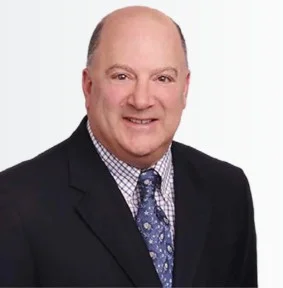
Richard has many years of experience representing health care practitioners in litigations, arbitrations, responding to government, regulatory board and insurer investigations, and other legal matters. Outside the office, Richard enjoys reading nonfiction and spinning vinyl records on his turntable. Richard also plays tennis when his body holds up.

Edward has extensive experience advising healthcare providers and related businesses on complex legal, regulatory, and reimbursement matters, including corporate governance, fraud and abuse compliance, licensure, and regulatory issues. He represents clients in government investigations, audits, and proceedings before federal and state agencies, licensing authorities, and insurance carriers. He also counsels clients on business formation, mergers and acquisitions, syndications, and other commercial transactions. Outside of work, Edward enjoys hiking, music, astronomy, and motorcycling.


Shannon Carroll | 973.403.3126 | scarroll@bracheichler.com
Riza I. Dagli | 973.403.3103 | rdagli@bracheichler.com
Lani M. Dornfeld, CHPC | 973.403.3136 | ldornfeld@bracheichler.com
John D. Fanburg, Chair | 973.403.3107 | jfanburg@bracheichler.com
Joseph M. Gorrell | 973.403.3112 | jgorrell@bracheichler.com
Carol Grelecki | 973.403.3140 | cgrelecki@bracheichler.com
Edward Hilzenrath, HLU Editor | 973.403.3114 | ehilzenrath@bracheichler.com
Caroline J. Patterson, Vice Chair | 973.364.5233 | cpatterson@bracheichler.com
Keith J. Roberts | 973.364.5201 | kroberts@bracheichler.com
Richard B. Robins | 973.447.9663 | rrobins@bracheichler.com
Jonathan J. Walzman | 973.403.3120 | jwalzman@bracheichler.com
Edward J. Yun | 973.364.5229 | eyun@bracheichler.com
Paul J. DeMartino, Jr. | 973.364.5228 | pdemartino@bracheichler.com
Edward Ellersick | 973.364.5205 | eellersick@bracheichler.com
Debra W. Levine | 973.403.3142 | dlevine@bracheichler.com
Erika R. Marshall | 973.364.5236 | emarshall@bracheichler.com
Tracy Miller | 973.403.3102 | tmiller@bracheichler.com
Vanessa Coleman | 973.364.5208 | vcoleman@bracheichler.com


STAY CONNECTED! FOLLOW US 




Attorney Advertising: This publication is designed to provide Brach Eichler LLC clients and contacts with information they can use to more effectively manage their businesses. The contents of this publication are for informational purposes only. Neither this publication nor the lawyers who authored it are rendering legal or other professional advice or opinions on specific facts or matters. Brach Eichler LLC assumes no liability in connection with the use of this publication.
